Unlocking the Mystery of Your Mortgage Escrow Math
When you get ready to close on a home, the numbers can feel overwhelming. You have mastered Principal and Interest (P&I), but then you hit the four-letter word that often confuses people: Escrow.
Your initial escrow deposit at closing usually represents one of the biggest chunks of cash you need to bring to the table. We get it—it can look arbitrary. But rest assured, the calculations behind your property tax and insurance escrow are precise, driven by a few key dates and a regulatory safety net.

What Is Mortgage Escrow?
Before diving into math, let’s confirm the basics. Your escrow account is a dedicated savings fund, managed by your mortgage servicers, solely for handling big annual bills related to your home.
It is the financial buffer that collects a portion of your monthly payment to cover property taxes, homeowner’s insurance (HOI), and any required mortgage or flood insurance.
The Homeowner’s Perk
No more panic when the $4,000 tax bill lands on your doormat! By paying a little extra each month, the burden of saving those massive, once- or twice-a-year expenses is completely lifted.
The Lender’s Requirement
Lenders require it because these bills protect the value of the asset securing your loan. If taxes go unpaid, the county can put a lien on your property. If insurance lapses, a fire or disaster could wipe out the collateral. Escrow is their way of making sure those two critical financial responsibilities are always met.

Breaking Down the Property Tax Escrow Calculation
Property taxes are the trickiest part of the equation because every local municipality—county, city, or school district—sets its own billing cycle. The critical factor is figuring out how much money is needed to be in the account on the very day the next tax bill is due.
The Logic Behind the Upfront Deposit:
Lenders use this simple, calendar-driven logic:
Find the annual tax bill: This is the total amount due for the year.
Determine the monthly share: Divide the annual bill by 12.
Calculate the shortfall: Subtract the number of monthly payments you will have made from the day your loan closes to the tax due date. Whatever is left is the “shortfall” that must be collected at closing.
Add the Cushion: Add a regulatory-mandated two-month cushion. This buffer exists to precent the account from going into a deficit if taxes increase mid-year.
Real World Example: Semi-Annual Taxes
Most areas split the tax bill into two installments per year (semi-annually). This means the first payment is due faster, and the upfront collection is higher.
Let’s assume your taxes are $6,000 per year, making your monthly share $500.
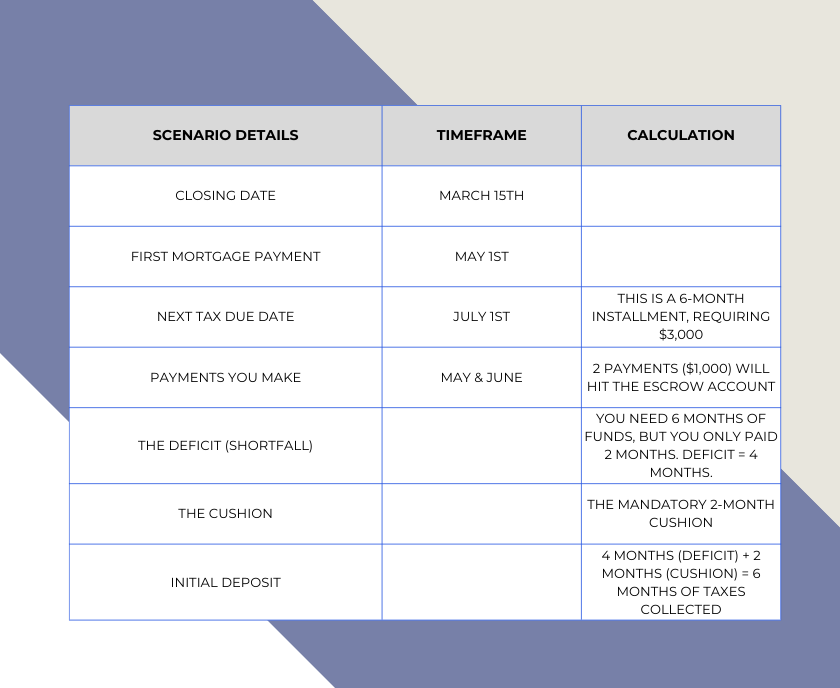
In this case, you would deposit 6 x $500 = $3,000 for property taxes at closing. This isn’t double-dipping; it’s making sure the $3,000 needed in July is there, while also building the required two-month reserve for the future.

Simplifying Homeowners Insurance Escrow
Calculating insurance premiums (HOI, Flood, MI) is much less complicated because they are usually due just once a year.
It is a standard procedure to pay the first year’s premium for your Homeowners Insurance outside of escrow to activate your policy before closing. This escrow calculation there is focused on collecting funds for the second year’s renewal.
The formula centers entirely on building that two-month cushion.
Example: Annual Insurance Renewal:
Let’s say your annual HOI premium is $1,200, which works out to $100 per month.
The Cushion: At minimum, we must collect the 2-month cushion upfront. That’s $200.
The Timing: Depending on the specific renewal date relative to your closing date, a few extra months of collection may be needed to ensure the account balance never drops below zero before your 12 monthly payments replenish for the next year.
The key takeaway is that the insurance escrow portion is designed to rebuild the fund for the next renewal while immediately establishing that required two-month safety net.

The Variable Factor: Your Closing Date
If you’re shopping around for mortgages and notice huge discrepancies in the escrow amounts on your Loan Estimates, remember this: the most common reason is a change in the anticipated closing date.
Shifting the closing date by even a week or two can alter the total number of monthly payments you make before a critical tax or insurance deadline. A change in the closing date means a change in the calculated deficit, which directly impacts the size of the cash needed upfront.
Understanding the “why” behind the escrow equation gives you full control and clarity over your home financing journey.
NMLS #1683459 (Co.) | AK16883459 | AL 1683459 | AR Authorized | AZ MB #0945139 | CA 60DFPI85027 | CO Approved | FL MBR3129 | GA GRMA 1683459 | IA 2025-0058 | ID MBL-2081683459 | IL EEP.0000017 | IN 66190 | KS MC.0026528 | KY EC885181 | LA Approved | MI FL-0026995 | MN MO-1683459 | MO 1683459-PU | MT 1683459 | NC R-221593 | ND NDER1683459 | NJ Approved | MPG-NV NMLS #2135318 | NV 5341 | OH TP.670107.000 | OR ML-5848 | PA 117573 | SC Approved | TN 1683459 | TX Approved | WA MB-1683459 | WI 1683459BR | WY 5498